Pillars of Salt

Infallible: immune from error because of ties to the church or God


According to the introduction to Pillars of Salt, the Christian state was comfortable playing the role of God and revoking life. Those responsible for Morgan’s death described it not as an execution but as his life being “turn’d off” by God. The primarily Catholic idea of infallibility must have transferred over to New England, which did not have a large Catholic population. Petty and relatable crimes, like “lying, cursing, or Sabbath-breaking” were emphasized to scare people into following the infallible will of the church and state. The condemned were not allowed to convey their own messages and instead were “manipulated” to convey a message not only of fear of God, but also of hope. Some men considered themselves “agents of God’s authority” and any actions they took were distorted to show that the morals of the church were right.


Performance: a dramatic representation of events


Performances were important to the change in punishment in America. Authorities pressured the condemned into performing rituals of penitence. Criminals also gained sympathy through performance. Packer attested his innocence and used the publicity of his death to shape his identity as a caring doctor and scientist rather than a criminal. Ames was accepted by the people because of his “credible family” and outward gentility, despite his clear criminal behavior.


Hierarchy: a system of ranking and order


Although criminals could express themselves through crime narratives, they could not escape American hierarchy and had to remain within this hierarchy in their texts. People would not accept someone who defied societal rules too much. Mountain never escapes the hierarchical system, even after escaping from the ship on which he served. His race was considered very important by the public. “Refusing to accept either his base social position or the baseness of his racial character, Mountain defied the standard conceptions that shaped the lives of those who read his narrative. Yet, as readers knew all too well, it was a safe defiance; given the requirements of the genre, they knew where, when, and how his defiance would end.”

Posted in divine, god, hierarchy, Infallible, performance, power, spectacle, theatrical | Comments Off on Pillars of Salt

foucalt chapter 2

1. truth – the aim of any justice system is to unearth the truth about the role of the accused in the crime committed. But the investigation for the truth did not always yield accurate “truths” because of the judicial torture that was employed to extract confession. Foucalt believes that the system in place did much more to produce “truth” than to actually find it through legitimate investigation. Determining the “truth” via torture both excused and encourage innumerable heinous acts.

2. power- the role of the public execution is one of power relations. It is the complete exposition of what happens if you decide to test the strength of the ruling officials. They serve as an example to the masses that although you may succeed in your criminal act but the system will ultimately extract its revenge. This steers the populace away from crime because of the prospect that they too may cry out mercifully from the gallows.

3. theatrical- the role of the public execution is one in which political motivations are accomplished by demonstrating brute force. This force is highly accentuated by the dramatic scene of a person on death’s door pleading for a pardon as their bodies are mutilated. The torture of a person for 18 days is done so that the image of this weary soul cannot escape you and serves as a constant reminder of the punitive system. Punishment often plucked the heart-strings of the public.

Posted in engl375mm, power, theatrical, truth | Comments Off on foucalt chapter 2

Pillars of Salt

  1. Humiliation- Humiliation, or loss of pride, took on two purposes. It was not only the stripping of dignity from the accused as part of the punishment, but for the onlookers, it was merely a form of entertainment. “New Englanders were encouraged to partake in the humiliation of public execution. In fact, the term “entertaining Death” is used to describe a criminal’s execution.
  2. Wrath- Here wrath is directly connected to God, however, the term can also be looked at from the perspective of many other individuals taking part in public executions, (for example, the wrath that overtook James Morgan in his drunken state when he stabbed someone). It can also be viewed from the perspective of the judge and executioners and the feeling they must feel when prosecuting someone and torturing them.
  3. God- God is personified in this chapter as the one who is really behind the punishment that the prisoners receiver. “God—and not the magistrates had assigned them their death roles.” The ministers are not really the ones doing the punishing, but are merely acting as God’s emissaries. Here we see another example of the ones responsible for punishment wanting to separate themselves from it, such as the vilifying of the executioner mentioned by Foucault.
Posted in god, humiliation, wrath | Comments Off on Pillars of Salt

pillars of salt

1. participate-to take part. pillars of salt does a thorough job of showing the individual participants in public executions and punishment. one, or maybe just me, would at first think the only true participant in an execution would be the person being executed as he or she takes the dominate role. however, this text goes to show that everyone, down to the plebian towns- people play an imperative role in a criminal’s execution. “but the people came not just to watch, they came to participate. it was not only the idle and the curious who gathered to witness a…spectacle; people from a variety of levels and areas assembled to experience a carefully staged public ritual.” the commoners participated as viewers, as supporters of a man’s hanging, as judges of his crime; most importantly, they were innocent participants. those who had not participated in sinful, condmening acts. aside from the commoners, the clergy participated. Their participation was in the role as savior; the main character responsible, via their moving sermons and speeches pertaining to the accused, for saving a man’s soul and the soul’s of onlookers and witnesses. “in order to reinforce the social order, in order to reaffirm the values that the capital crime had threatened, minsters and magistrates collaborated in presenting Morgan before as many people as possible, and through their direction the ritual of death dramatized the condemned man’s struggles to escape a firey hell.”

2. death– the termination of life takes on a completely different meaning in Pillars of Salt. It was not just the act of passing away, but a form of entertainment. in terms of Morgan’s and Rodger’s executions, the said purpose of the public affair was to warn others of the outcome of wrong doing ON YOUR SOUL. however, perhaps the intention of the crowd was to witness something never before experienced. in fact, the text even states, “fully aware of the popular fascination with death. ” the onlookers are also actually referred to as an “audience.”

3. conversion– ultimately a change, i found the contrasting usage of the term, in comparison to that of Foucalt, very interesting. in this text, the interest in conversion was not placed on injust to just, but rather on sinner to non-sinner, wretched to holy. a criminal’s conversion is looked upon in this instance from a much more religious standpoint. “ministers became in- creasingly involved with arousing a more personal, evangelical form of piety.” and “criminal characterization similarly reflected this evangelical fervor, and narrative emphasis shifted from the individual’s desperate distress to his or her confident faith in Christ’s merciful love.”

Posted in confession, conversion, death, pain, participate, torture | Comments Off on pillars of salt

foucault “the spectacle of the scaffold”

Truth- The justice system being described by Foucault has an interesting concept of truth and falsehood, guilt and innocence. It “did not obey a dualistic system: true or false, but a principle of continuous gradation” (42). In this way, minor punishments are given to people who are accused of horrible crimes but have only minor evidence against them: they are a little guilty, so receive a minor punishment since their absolute culpability cannot be established.  Although this certainly seems very odd to us, it seems like a strangely modern idea: the accused is only as guilty as the evidence suggests.  It is not exactly innocent until proven guilty, but still only as guilty as you are proven.  The idea of physical punishment is very tied up with the notion of truth, as in many circumstances torture and execution is done with the objective that “the body has produced and reproduced the truth of the crime” (47).

Secrecy-The justice system in Europe remained secret from not only the public but from the accused.  Foucault notes that “knowledge was the absolute privilege of the prosecution,” as the accused had no idea who was accusing him, any evidence or documents being used, or the names of any witnesses against him (35).  The modern day justice system is an interesting reversal of this, as we currently make a spectacle of the arrest and trial, while punishment is kept secret. While the spectacle of public torture and execution was intended to reveal truth, the secrecy of the justice system was intended to limit the knowledge of the truth to the magistrates and judges.
Spectacle- Part of the reason that there is a spectacular element to punishment is so that the public will be deterred from committing crimes: “men will remember…pain duly observed” (34). Perhaps more importantly, though, punishment and torture must be a spectacle so that the public can witness the triumph of truth and justice; this is the “ceremonial of justice” (34). In this way the guilty man becomes “the herald of his own condemnation,” every ritual procession and reading of the sentence reinforces the triumph of truth over the accused (43). The public punishment of a condemned man was less about him and more about the audience: as Foucault notes, “in the ceremonies of the public execution, the main character was the people, whose real and immediate presence was required for the performance” (57).

Posted in secrecy, spectacle, truth | Comments Off on foucault “the spectacle of the scaffold”

Discipline and Punish: The body of the condemned

Note: I found your post on Foucault, Brendan!

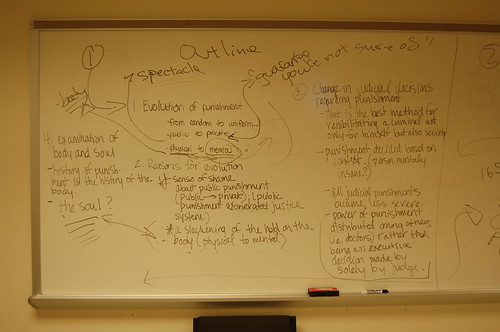
metamorphosis– Foucault is detailing the complete change of the punitive systems in place. The spectacle of public executions are a thing of the past as well as the intense physical pain that used to be inflicted. Now there is a much larger focus on the role of torturing someone’s soul rather than their body. The new process of punishment also encourages personal change within the criminal. the nature of punishment takes a new form following the early nineteenth century.

diagnostic– within the new punitive system judges begin to take into account more than simply the criminal act preformed. Instead crimes are now placed in context and evaluated on a case by case basis where the best interest of society and the rehabilitational prospects of the criminal are taken into account. Things such as mental capacity, stability now factor into how a criminal is dealt with.

deprived– physical pain is not the best medicine for a criminal any longer, now the mind is the target. By stripping criminals of what they believe are they basic human rights, the criminal’s soul is left in turmoil to anguish over what they have done to get them where they are. The public is also deprived because they are no longer privy to the gory details of public execution. Instead of bearing witness, they are left with the thought of an inevitable punishment, that awaits the sentenced person.

Posted in deprived, diagnostic, engl375mm, metamorphosis, transformation | Comments Off on Discipline and Punish: The body of the condemned

To do list…

A few things to note:

* I posted the second chapter of Foucault on the readings page as well as the Introduction to Daniel E. Williams’s Pillars of Salt (please read both this weekend)

* As I said yesterday, I would like you to examine the 4 points of methodology that Foucault mentions in the chapter we discussed yesterday, and think about (or research) this idea of genealogy that he discusses in relationship to his method.

* If you haven’t posted for the first two readings, I expect that you will shortly.  If you have any questions about posting, please contact me.

* I talked a bit about categories and crossover last night.  I would like each of you to read on another’s post with the lists of categories, and see if you might be able to incorporate these categories into your own posts.  In other words, are others using another term for a category where two, or more, of you are hitting on the same principle?  If so, don’t add it as text to your post, but just edit the post and add (or check mark) the category box with this alternative term -is this clear?

* From here on out please be specific about the reading we are doing for you responses on the blog.  And make sure the responses you have already posted clearly define the work you are talking about. You should also edit your previous posts to make sure the title of the work and chapter are clearly defined.  And don;t be afraid to get more specific with post titles!

* Additionally, be sure that each separate reading over the weekend gets its own blog post (i.e. one for Discipline and Punish Chapter 2 and a separate one for Pillars of Salt Intro)

Posted in todo | Comments Off on To do list…

Framing Foucault

Here’s a still frame of a very dynamic and fascinating discussion.

DSC_0012.JPG

Posted in Foucault | Comments Off on Framing Foucault

2nd reading

Adaptation – “adapting punishment to the individual offender” Over the years this standard still previals.  What has changed however is the severity of the punishments.  Death has been hailed as the ultimate punishment for the most gruesome and horrible killers that are caught in our country rather than as a punishment for anyone who has taken a life.  As the mentality of society changed so did the punishments.  “the execution no longer bears the specific mark of the crime or the social status of the criminal; a death that only lasts a moment.”  Another way adaptation can be viewed is the removal of the responsibility from the government.  “Justice is relieved of repsonsibility for it by a bureaucratic concealment of the penalty itself.”

 Routine – When executions and punishments were kept as routine events in the public the awareness of one’s actions and resulting consequences for those actions were prevalent in society.  After these executions and punishments were removed public view it died down from their interest completely.  A routine helps to enforce the laws that are being set up.  With the removal of the executions more and more fellons filled up the prisons.

Pain – The concept of pain evovled over time.  At first there was a devotion to bodily pain, and torture reigned in the penal system.  Over time there was a move from the object of punishment from bodily pain to mental.  “take away life but prevent the punished from feeling it” 

Posted in adaptation, engl375mm, pain, routine | Comments Off on 2nd reading

Foucault

Cruelty:  causing unnecessary and especially painful suffering.


This chapter suggests that the notion of cruelty has changed from the 1700s to now, and even from the 1700s to the 1800s.  It opens with a strikingly grotesque narrative from an officer witnessing an execution in 1757.  The first sentence describes the punishment:  “The flesh will be torn from his breasts, arms, thighs, and calves with red hot pincers.”  The narrator tells of the “indescribably pain” almost matter-of-factly.  It seems commonplace.  He talks about the repeated (failed) efforts of the horses to pull the man apart, and the final decision to hack the man’s limbs off instead.  He tells us that the man is still alive after all of this.  There are theories that we, in this society, are desensitized to violence, but to most of society, this kind of spectacle is unthinkable.  It seems that people were exposed to more graphic and real violence in the 1700s.  Foucault says “It was as if the punishment was thought to equal, if not exceed, in savagery the crime itself, to accustom the spectators to a ferocity from which one wished to divert them…”


Humanization:  compassion stemming from the acceptance of other individuals more or less as equals.


Foucault argues that humanization of criminals did NOT (alone) cause the change in the nineteenth century from public to private punishment.  He argues that some ignore the change because humanization is an easy explanation.  The shift was more political.  If punishment is hidden from the public, the criminal alone is vilified, not the justice system.  Foucault says “It is ugly to be punishable, but there is no glory in punishing.  Hence the double system of protection that justice has set up between itself and the punishment it imposes.   Those who carry out the penalty tend to become an autonomous sector; justice is relieved from responsibility for it by a bureaucratic concealment of the penalty itself.”


Consistency:  uniformity


In order for punishment to be effective, it must be consistent.  In the shift away from bodily punishment, uniformity was introduced.  Around this time “great institutional transformations” occurred:  explicit laws and rules and, a nearly universally a jury system, were adopted.  Hanging machines were instituted in England and a law in France stated that every man sentenced to die had to be beheaded.  It became more difficult to escape from punishment because of class or connections, and punishment became more effectual.


Ritual:  a custom or ceremony


Foucault repeatedly refers to the process of punishment as a ritual.  The unnecessary torture of criminals described here sounds very ritualistic.  Quartering prisoners was dramatic and intended to affect the audience.  Foucault says that with the end of torture, the ritual of murder loses its theatricality:  “The disappearance of public execution marks therefore, the end of the spectacle…”  He still describes modern punishment and execution as ritual, however.  He says that the inclusion of a doctor in modern executions is a ritual.  Perhaps some modern rituals are designed to make the justice system look humane.  The technique of determining madness he describes is a ritual, as are the means of controlling prisoners without bodily harm.  The ritualism of the court system is less obvious today, but just as present.  His discussion of violent ritualism in the older court system brings to mind the ritual degradation described by Monster:  it has no practical, immediate effects, only psychological ones.

Posted in Consistency, Cruelty, Humanization, Ritual | Comments Off on Foucault