second definitions

1. transformation– a change in appearance, nature, and character can be seen throughout this entire reading. obviously, the change in appearance is most obviously applicable to a body changing physically while subject to torture like that of Damiens in the opening of the chapter. “the flesh will be torn from his breasts, arms, thighs and calves with red hot pincers…finally he was quartered.” this depicts an extreme change in a human corpse, the breaking down of a whole into smaller portions which have also undergone a gruesome transformation themselves. “the whole was reduced to ashes.” this word can also be looked at from the perspective of the transformations that types of punishment have undergone through time. At the beginning of the chapter we are introduced to a very primitive, barbaric torturing device: horses. “then the ropes that were to be harnessed to the horses were attached with cords to the patient’s body; the horses were then harnessed and placed alongside the arms and legs, one at each limb.” Some years later, another form of punishment is described: “Eighty years later, Leon Faucher drew up his rules for “the house of young prisoners in Paris.” Article 17-28 describe how the emphasis has been removed from torture completely and placed rather on strict routine. “by the end of the eighteenth and the beginning of the nineteenth century, the gloomy festival of punishment was dying out…the use of prisoners in public works, cleaning streets or repairing highways, was practiced.”

2. justice– this idea of rightfulness and lawfulness in a way fuels this entire article. Why was torture used? why do we have prisons today? I believe societies’ drive to correct and improve whatever it deems unjust or punhishable is fueled by its incessant desire for justice…or a shape or mold that an individual society sees as being right…and in the same way, removing those aspects that each society has decided is not right. This term justice as presented in this article shows the relativity of the term. Back to Damiens, the French at this time found it just to punish someone by torture in order to correct the person’s unjust act. What was his unjust act? Although the act is never stated, in America’s infancy, only some 50 or 60 years later, justice was never sought out by the supreme lawmaking body of our country, regardless of the crime in the dismemberment of a human body as Damiens’ was in France. This article shows the means by which a society will act in order to create a just environment.

3. body– the body is the physical structure of a person, a corpse. While reading this article I realized that I have been perceiving the body as an entity directly connected to the brain and soul. However, the article really showed how the body, soul, and mind are separate entities. For example, with Damiens again, what were the people actually torturing? They were only torturing the physical body, the corpse…as if the body had commited the crime. is tearing apart a body punishing the aspect of the person that is responsbile for the crime? even if it is to try and reveal the mentality of the person through pain, the actual corpse is the only thing being punished since the mind and brain will be dead, leaving no room to correct an injustice. “physical pain, the pain of the body itself, is no longer the constituent element of the penalty.” Toward the end of the article and as the judicial system has evolved, I feel that this point has been considered. They speak of “meidco-judicial” treatment rather than torture.

Posted in body, justice, transformation | Comments Off on second definitions

body of the condemned

Spectacle- Foucault argues that as the “gloomy festival of punishment was dying out,” one of the first things to go was “the spectacle of punishment”.  He uses the word spectacle to describe the public torture and execution of prisoners used until the eighteenth and early nineteenth centuries.  What is particularly interesting about the word spectacle is that it serves more of a function for the viewers than for the person being punished.  Interestingly the spectacle of public executions was criticized, although they continued to be carried out.  Foucault traces the end of the spectacle of punishment and notes that now a prisoner’s trial is watched by the public rather than his punishment.  Although this chapter certainly does focus on a prisoner’s physical punishment, the use of the word spectacle suggests that any public display of physical punishment becomes psychologically painful as well.


Judge-  Foucault’s first real mention of judging is on page 21 with his mention of a trial judge who “certainly does more than ‘judge’”.  The notion of judgment, however, is prevalent throughout this chapter: those watching a public execution are judgmental of both the condemned man and the public punishment that he faces (as we see through multiple criticisms of the practice).  Foucault notes that in the penal system more people have the power to judge (psychological experts, magistrates, etc) than actually have the power to punish.  The new legal system seems to have “led judges to judge something other than crimes,” they must determine an appropriate punishment, and often “pass sentence not in direct relation to the crime”.


Blame- Foucault notes that when punishment shifted from the public to private sphere, “the apportioning of blame is redistributed”: that is, the shame of a public execution which often brought “pity or glory” to the victim has been replaced by a more secret shame of a modern execution, something that is made private in order to separate it from the justice system that ordered it.  The secrecy surrounding executions makes them seem more like a necessary evil than a spectacle that the public is a part of.  The increasing secrecy of executions seems to point of a sense of shame about the penal system, a feeling that the justice system is blamed for them.  By eliminating the “glory in punishing”, the justice system separates itself from the ugliness of executions and the blame that they receive for them.

Posted in blame, judge, spectacle | Comments Off on body of the condemned

Monster

Monster: A creature whose identity is created (or distorted) by the imagination or legend.


The behavior of gang members is like a legend based on distant stories that becomes real to the people working in the prison system. Monster seems to be an apt name for the author because, as a gang member, he is treated as something dangerous and inhuman. The officers retaliate disproportionately to his disobedient acts because they are afraid of something vague and intangible. According to Monster, their fear extends beyond gang members to young black men in general.

Illegitimate: Something that is not accepted by the mainstream or does not fit into the usual processes of a culture.


Monster is not accepted by his “father” because he is illegitimate. Although he grows up with Scott, Scott is unwilling to accept him as his child because it culturally unacceptable to embrace a child that was born of an affair. Later he finds it easier to adapt to an illegitimate living and join a gang than to be successful the legitimate way. Because he is poor, it would be difficult for him to get the college education which would enable him to get a good job. The book suggests that white people, who comprise the majority of society, are afraid of young black men and gang members. If this is true, it becomes nearly impossible for him to make a legal living once he becomes involved in a gang and goes to jail.


Misrule: Governance that comes to resemble anarchy because it is misguided.


All the groups of Crips follow strict rules, but they lead to civil war among the Crips. In jail, the different groups of Crips are still fighting even though there are few of them and they have other enemies that want to kill them. Even among the Crips that want to unite, the leadership is conflicted and Monster realizes that it is flawed and self-destructive.


Posted in illegitimate, misrule, monster | Comments Off on Monster

1st reading

Fear: All of the prisoners are ruled by fear. Life is lived in a constant state of emergency. Death is a permanent factor in prison life. Many of those who are imprisoned are not afraid to continue killing, even knowing the consequences of their actions. Many are living out life sentences in jail and don’t have anything to lose by killing. So without friends and comrades to watch over you while serving your term fear will be the overriding presence felt in prison.

Alliance: Throughout the entire chapter there are reminders that to survive in the jail system in America it is helpful to be connected to people who will have your back at all times. With numbers there is saftey and security. Often times peace was established when groups became allies and the number of enemies are decreased.

Distrust: For Monster along with the rest of those who were members of gangs, the law was to only trust those who were in their gang. Any one not in their gang was not to be trusted and the standard was kill or be killed. Not only were those of different sets not trusted but the authorities as well. Those put in power over the convicts often misused this authority and enforced practices that degraded the prisoners with the intent of tearing them down mentally. Not knowing who was good or bad causes anyone caught in the penal system to distrust anyone that was worthy of being deemed a threat.

Posted in alliance, distrust, fear | Comments Off on 1st reading

just punishment?

Hi my name is Quintalis Hill. I’m a sophmore at the University of Mary Washington. I use Google to search

Posted in quintalis | Comments Off on just punishment?

first definitions

1. repression– i think this term is truly defined through the life of Monster while in the various penetenteries. Nothing is more repressive than being controlled behind metal bars, concrete walls, loss of contact with the outside. In helping to understand the text, I feel that this word and its meaning truly gives the reader a sense of the atmosphere and environment of being in prison, which, like we talked about yesterday, is something none of us has experienced. He speaks several times of the “steel covering over the window in my door” while in Deep Seg and of the darkness that physically penetreated every aspect of his being. Also, “I sat there in total darkness, in total silence, repressed to the max.”

Also, to speak in terms of crossover or “hybrid” ideas, another idea expressed in yesterdays class, Monster touches on a more psychological meaning of the term when he talks about his writing his true biological father. “I tried to write him, but found the pain too great… the questions started to surface: where have you been? why did you abandon me? i needed you man, and you weren’t there for me.”

2. resistance the opposition through force is spoken of heavily in the text. “I cut my bed up for weapons with a hacksaw blade.” How many times in just this one chapter does Monster bring up the creation of weaponry while behind bars? In relation to the craftsmanship of these weapons but also touching a more physical sense of the resistance, “I found a piece of metal loose enough to get my hand under, so I slid halfway beneath the bed, braced my foot against the wall, and began to pull violently. Heave-ho, Heave ho. Back and forth I pulled.” The idea of resistance really gives insight into the whole tone of the the chapter. At no point, really, is there an absence of resistance. There is always talk of war, self-protection.

3. alliance– the merging of separate organizations and individuals in the various prisions and the mutual agreements between specific groups of people are a key aspect within the chapter. “Three days later I was moved to the back bar, where my comrades were. All around me were comrades and allies.” Also, “I am Italo from the Black Guerrilla Family. Perhaps you know some of my tribesmen? All your people are in the back. We, B.G.F and B.L. have peace treaty with the A.B. and E.M.E on this tier…In struggle, Italo” The idea of alliances and allies offer perhaps one of the only positive aspects of the prisons. Monster being able to find lost acquaintances: “yes, I did know him! He and I were friends from the seventies.” While offering insight into a positive side of Monster’s experience while behind bars, the term simoultaneously points out negativity as well since there is constant clashing of various alliances, for example the constant war between the C.C.O and the Southern Mexican vanguard independent alliances and within the prison walls, and as only one small example, the pigs against Monster’s alliance, the crips. The strong allegiance of one’s individual alliance within the confinements of the prison really give the reader a sense of the constant turmoil between men and the incessant never-at-rest sense that seems to be present in Monster.

Posted in alliance, repression, resistance | Comments Off on first definitions

reconnected reading

Politics– Shakur first mentions politics by saying that he is no longer in a place where politics is not important. He tells his cellmate that he doesn’t understand that the the prison system has its own set of politics, involving power struggles between groups such as “B.G.F, E.M.E.,” and so on. Politics is important to Shakur to establish his place both within the prison community and within the Crips. The gang seems to be a very political organization, with set agendas and a formal internal structure. The different gangs function as political entities who declare war on each other and also establish peace treaties.

War– Shakur often describes himself as a participant in a war, a soldier who receives training. He mentions an “alert period” in which every “soldier” has to be dressed and out of bed. During the the rest of the day, the soldiers are educated and trained. Seeing Shakur as a soldier seems to make his strong identication with a violent organization more relatable. As he says, he believes in what he is doing. As a soldier, every aspect of life is controlled by the prison system or thegang system.

Degrade– Shakur’s obsession with the war and politics involved with crime both inside and outside of the prison system is made more understandable when we consider the conditions to which he is subjected. He first explains the strip search ritual performed at all prisons, explaining it as simply a “ritual designed to degrade”. He is, with no real explanation, placed in a cell with no light, a dirty place he is not permitted to even clean. Shakur is kept in such dark conditions that when the lights are finally turned on it seriously hurts his eyes. He states outright that the degradation and repression he endures in many ways breeds his resistance.

Posted in degrade, politics, war | Comments Off on reconnected reading

Crime etc.

My name is Molly; I use Google. 

Posted in Molly | Comments Off on Crime etc.

Welcome to English 375MM…

also known as “Discipline & Punish: Early American Crime Narratives”

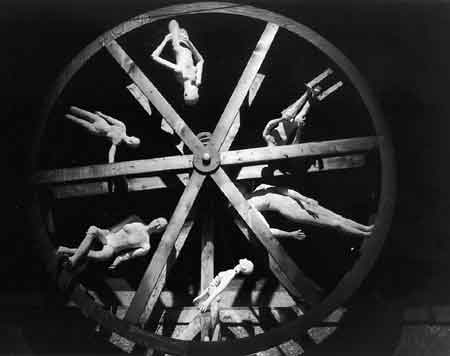
Witch Wheel

Image from JMuse

Posted in engl375mm | Comments Off on Welcome to English 375MM…