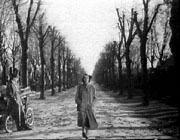
Box Office Poison killed Beth March.

1933 was a long time before Katherine Hepburn was labeled (Libelled, she’s not a pickle jar!) as “Box Office Poison,” a term she later was thankfully able to shake, and I think her independent nature fuels Jo and brings her to life, it’s not often that a character and actor are so close in spirit.

I liked how the characters, mainly Jo and Amy, were introduced in this George Cukor adaptation, since first impressions are always important and a film is no different. Having Jo at her aunt’s home, trying to sneak out of reading out loud, resulting in a shouting match and her pleading so she could work on a play. In less than 5 minutes we know the details of her job, her temper, her passion for creativity, and her skill for talking her way out of things. With Amy too we see both her lack of interest in school and how, when she is caught, she does not take punishment well. Always show rather than tell, and I think Cukor managed to show quite a bit to his audience.

Just as the film strongly establishes Jo and Amy, it also manages to give Laurie an awfully bad hand. From the first time he opens the window to say hi, we see Laurie as buffoonish. He may have his moments like at the party, but Laurie definitely conjured up the most laughter for his all-around hokey attitude. Though it may have been due to the culture/time difference between my generation and the 1930’s, it appeared to try and prove to the audience just how bad Laurie was for Jo. The portrayal of Bhaer offered a lot more humility and patience than the portrayal of Laurie.

While watching, this idea popped into my head that there may be a connection with this post-Civil War book, and how its film adaptations also always following major international conflicts. The 1933 one is a stretch, since WWI ended in 1918, but the other adaptations are all a few years after American military campaigns. WWII – 1949,
Vietnam – 1979, and Desert Storm – 1994. Little Women certainly does offer a lamentation for those who are away fighting, what with the March girl’s father away, but I don’t think this means that there is some deep underlying message due to that, instead maybe it’s just an example of how America loves both this novel and getting it’s war on simultaneously.

Finally I’d just like to point out my favorite exchange of dialogue:

“Christopher Columbus!”

“Oh Jo, don’t use such dreadful expressions!”

Posted in Little Women | Comments Off on Box Office Poison killed Beth March.

Mothra Loves Little Women

I’ve seen the 1994 version of the film, and I was ten then, so a lot of the passages of Little Women seem familiar to me in a kind of vague way. We heard Dr. Campbell read that quote about Theodore Roosevelt being very taken with the novel. I believe the term “worshipped” was used.  I think it makes perfect sense that he read it, for Roosevelt was just a sickly 9 years old when the book was first published, not the mustachioed, panama canal establishing, rough rider safari-master president that our minds immediately jump to. What else is he going to be doing back in 1868, playing hoop-and-stick?

Robyn has a very good post on how many people identify with Jo, citing her charisma and spirit as the ideal features we wish to relate to. I think another important aspect is that we do have one very large connection with Jo. Even if one doesn’t like the book that much, it’s impossible to deny the fact that very much like Jo, we are all readers. Also, since we are enveloped in the medium that Jo dominates, thanks to her voracious literary appetite, she ends up coming across best for that particular medium. Now maybe if this narrative were translated into a “Peter And The Wolf”-like recording, Beth’s musical prowess would allow her to (heaven forbid) dominate. Or if it was some MTV reality show where the main character’s mission are to be a stuck up little bitch, well I think Amy would definitely succeed in that otherworldly realm.

Posted in Little Women | Comments Off on Mothra Loves Little Women

mmmmmm…smells like prejudice.

Johnny Caspar is the most obvious element in the Coen Brothers attempt to magnify ethnic differences in Miller’s Crossing. In order to succeed in the business, Giovani Gaspari had to change his name to something a bit more Anglo. Even when his gang is on the up and up, the mayor gives him the run around. Johnny calls it “the high hat” and Tom addresses it as “Double Talk.” Whatever term you go by, you see quite clearly that political corruption isn’t the mayor’s only problem at hand. He’s got some issues with race too.  Johnny’s vendetta against Bernie also seems to have some racial complication in it, namely that Leo isn’t about to let an Italian call the shots on a Jewish friend. Then you have Tom and Eddie, both right hand men and both ethnic outsiders. Tom’s Irish background, as well as his brains, seems to allow him to move in between since he has no ethnic ties to either side. Eddie the Dane (originally to be played by Peter Stormare, who the Coens always use in innovative ways) is also an outsider, and manages to keep his head clear of prejudice, observing things clearly and being equally ruthless to just about everyone. 

The Glass Key seemed to touch on these issues a bit. Madvig seemed to be a WASP while Shad O’Rory’s Irish background was quite evident. The 1942 film changed O’Rory into a more ambiguous ethnicity, though he seemed Italian to me. Yojimbo may have had some cultural rifts, but since I know little about feudal
Japan, I cannot identify what they are if there are any.
 Verna’s moment in the film was quite wonderful. Repeating “Drop dead.” To Tom while walking past him was a great punctuation mark, both repeating the line she says most throughout the film, and also a nice homage to The Third Man. 
a woman's scorn

Martin Scorcese actually just referenced the same scene at the end of The Departed, if you have the pleasure of seeing it. Such instances are great examples of how films live, grow, and manage to shape each other.

Posted in The Glass Key | Comments Off on mmmmmm…smells like prejudice.

The Coen Brothers Know What They’re Doing

I first saw Millers Crossing when I was 12 or 13, so watching it a decade later was like having a dream come back to me after years of faint recollections. Of course it had the recognizable faces I see in so many Coen films: Frances McDormand, Steve Buscemi, John Turturro, and in maybe his best Coen role, Jon Polito.

I found violence to be one of the most varied elements when discussing how the filmmakers adapted the Glass Key. Most of the punching was very similar to a 40’s film. But there were minor deviations, such as when Tommy rejects Johnny Caspar’s first proposition. Caspar leaves him in there with the Muscle Henchman, who takes his time getting ready before he beats Tommy (Note how the camera in the scene is on the floor, very similar to many scenes in Citizen Kane, it makes the Henchman nearly double in size as he walks towards Tommy) Right when you expect to see a harsh beating, Tommy hits him with the chair and we see a seemingly one dimensional character suddenly become hurt both physically and emotionally, he stumbles out of the room, and it’s the smaller guy who comes back to punish Tommy. To me, that’s recuperation of myth as myth. We all mentally stopped when the big guy couldn’t handle the violence, and then everything managed to start right up again.

Gun violence is completely different, especially in the scenes where Leo evades assassination and manages to kill everyone involved in the attack. He marches down the street like Arnold Schwarzenegger with a tommygun and a beautiful scowl. I find this to be more than Nostalgia or Burlesque, it is an exaggerated stylized display of gangster perfection. Likewise the chaotic police raids were a throwback to the inept authority you see in Fritz Lang’s M, and visually like Seibei’s and Ushitora’s men in Yojimbo right after Sanjuro decides not to partake in the first showdown. In both, warriors run around without purpose, utterly ridiculous.

I noticed early on that Leo and Johnny, when they are behind their desks, will often sit with their body facing to the side (often with shoes up on the table). Such behavior is a subtle form of disrespect. Leo first does it to Johnny, and both Leo and Johnny do it to the mayor and the police chief. The only person they completely face is Tom.

Perfect example of Leo's body language.


Such action is a wonderful detail that Tom really has earned respect from both sides. (When the Dane has found out that Bernie is still alive, Johnny does not face Tom. With that body language, one could see that there was an important obstacle in their relationship, which eventually led to Johnny favoring Tom and killing the Dane

Buscemi and Turturro in a way are members of the same sort of element. They are “The Little Guy That You Can’t Trust.” Peter Lorre practically made this character a facet of
Hollywood gangster films. Buscemi seems to be playing TLGTYCT for burlesque purposes. The motormouthed bug eyed exaggeration is very humorous, but still manages to fit within the film. Turturro is more of a threat to Tom, though he may be funny at times, he definitely is not just there for comedic value.

There’s a lot to be said about Miller’s Crossing, so I hope to write a few more blogs in the next week, especially one about ethnicity being a much more overt theme in the film than in The Glass Key.

Posted in The Glass Key | Comments Off on The Coen Brothers Know What They’re Doing

Film Filled Weekend

Over the past three days, I’ve watched movies for 16 hours. A really strange array of flicks actually, but some of them had definite connections to The Glass Key and Yojimbo.  Some I had seen several times, others were very new to me.

Out of the Past: I watched this after Dr. Campbell’s recommendation during the Noir discussion. Robert Mitchum is one of those great actors that never had the adoration that Gregory Peck or Jimmy Stewart (In fact, Mitchum’s death on July 1, 1997 was greatly overshadowed by Stewart’s passing the following day). His role as an ex-private eye who became tangled up with a mobster might not reach the bravado of Night of the Hunter (my personal favorite), but his acting was certainly competent in a film that employs all Noir calling cards. Dark shadows, double crossings, and one deadly dame. Interesting that the quintessential Noir flick starts and ends in a small backwater town. It certainly doesn’t stay there though. The scenes in Mexico reminded me greatly of something out of Casablanca and San Francisco supplied the big city badness. Since it was my first viewing I surely missed a lot, but I hope to watch it a few more times, especially with the commentary by Noir expert James Ursini.

Star Wars: A New Hope: The second I turned on the TV this morning, those rolling credits started and I was hooked. I haven’t watched the A New Hope sine Episode III came out when I had to remind myself again why I had been so crazy about this trilogy for a decade of my life. Of course it holds up, taking heavily from genre films like Westerns, Flash Gordon Serials and WW II Fighter Plane movies….not to mention the obvious influence of Kurosawa’s films. The Jedi simply couldn’t exist without the the cinematic portrayal of Samauri.

Shane: The first time I saw this was for Dr. Kemp’s 245 class, and to be honest, I didn’t make the connection that Alan Ladd played the title role in what is probably the most important pre-1960’s Western (High Noon might be a nose ahead). This role really captures a broader acting ability much more than Ed Beaumont. Sure he gets roughed up, but we finally get to witness him throwing a few punches of his own. Ladd has this beautiful ability to peer out of the corner of his eyes in both films, he rarely turns his head when he sees something of interest. It was certainly more subtle in Shane than The Glass Key. Likewise Shane has connections to Yojimbo. I took special note at how feminine Jack Palance appeared (much like Unosuke). But while Unosuke’s gun weilding threatens Sanjuro’s feudal role and must be stopped to preserve his purpose, Shane actually is bringing about his own end by letting the homesteaders keep their land. This allows the West to become a tamed sanctuary for settlers, which neither Shane nor Palance’s Wilson can really exist in.

It’s late now, and I probably sound nuts. I hope Dr. Campbell got to read some of Sex, Drugs, and Cocoa Puffs. Everyone should have a copy of that book.

Posted in Criticism | Comments Off on Film Filled Weekend

The Myth Of It All

In adding to the evidence that Yojimbo is dealing with a more mythic narrative than The Glass Key, I think viewers need to look no further than a striking difference between Sanjuro and Ed. While both of them are very clever and witty, Sanjuro (a trained warrior) is more apt to follow through with the threat of physical violence than Ed is. Ed constantly relies more on charm (a characteristic that Sanjuro lacks, or simply ignores) to win his battles. Charm and wit seem quite acceptable for Ed’s world. Likewise, strength and wit are extremely beneficial to Sanjuro. If we relate the fight in Yojimbo to Lucas’ Star Wars, who is that character replacing Sanjuro? Obi-Wan Kenobi, who is certainly one of the most spiritual/mystical character in the film. Charm? That’s for the mercenaries. Han Solo is Ed Beaumont. He lacks a real history or mythology and works with gangsters. Sorry to get on a slight sci-fi tangent…. and no, Chewbacca is not Paul Madvig. Is Sanjuro a mercenary? Or is he a force that not even money can direct and change?

The story of Yojimbo itself hearkens even further back, over centuries really. This idea of a figure being able to play two opposing sides, profiting from their mutual destruction is evident in Greek and Norse mythology, with trickster gods pitting two superiors against each other and reaping the benefits. The Anansi stories of Africa and Native American trickster tales are as equally influential. The difference is that Sanjuro is not sneaky like these earlier figures. As the hero, he manages to find usefulness for his training. He asks for little in return and does not linger once his job is complete.

Posted in The Glass Key | Comments Off on The Myth Of It All

Kurosawa, can you do no wrong?

Right off the bat, let me say that Toshiro Mifune is spectacular, the single best actor in the Eastern hemisphere. Whether the man is maliciously pompous, heroically headstrong, or full of arrows, Mifune has a presence that is often memorable and always magical.  

 Mifune will take names later

Yojimbo is certainly the lightest Kurosawa movie I’ve had the pleasure to watch. Usually he deals with epic themes with many more supporting roles than this. I certainly enjoyed the plot, knowing what to expect due to my fascination with Spaghetti Westerns (Kurosawa originally sued Sergio Leone for adapting the film into A Fistful Of Dollars, but said he quite liked the remake years later). I can see how this film is a bridge between American Westerns of the 40’s and 50’s and Leone’s terrific reimagining of the genre in the 60’s. I can also see different plot points of The Glass Key, especially Sanjuro’s time being beaten and held captured. Most articles on the film also cite another Hammett novel, Red Harvest, as the main inspiration. I hope to check this book out sometime in the near future, knowing now that I can handle Hammett’s writing style.

It’s interesting how many of Kurosawa’s films are taken from other cultures, whether it be Hammett, Shakespeare, or Russian Socialist Drama. Even better is how his films resonate back to Western culture and are then proved timeless with their own adaptations, in the way that The Magnificent Seven and A Fistful Of Dollars have This exchange of ideas allow people to see cross-cultural similarities that makes us all feel a lot more familiar with one another.

Posted in The Glass Key | Comments Off on Kurosawa, can you do no wrong?

Merry Marketing and Idealistic Inspiration

I understand how the trailer for The Glass Key tried to pass it off, especially relating it to Hammett’s popular Thin Man series. Ed and Paul certainly had lighter demeanors and more personality. There’s that phrase ringing in my mind that the trailer is the studio’s representation of how they wished the movie to be. By that indication, the studio wanted this film to be an action filled romp through the criminal underbelly. The book does have action in it, in fact, that’s all the book is, physical I mean.

 The schism between Jeff and Nick (Shad in the book) puts me in the mind of a film that came out last year that impressed me very much, and ultimately made my pick for the best film of 2006. Rian Johnson, a first time director decided to take his love for Hammett novels and make a hard boiled detective film in which teenagers were the heroes, the vamps, the villains. Brick, the film in question,  is set around a suburban high school and involves a loner protagonist (Think of Ned in blue jeans and no moustache) investigating a criminal drug ring in order to find out what happened to his recently killed ex-girlfriend. Much like in The Glass Key, a large amount of the end plot is devoted to an angry split between the kingpin of the drug ring (Lukas Haas, best known as the Amish kid in Witness) and his thuggish henchman. Johnson states quite passionately that Hammett, along with Miller’s Crossing (which we’ll be watching later) inspired him greatly in this effort.

Here you can find the trailer for Rian Johnson’s Brick

Posted in The Glass Key | Comments Off on Merry Marketing and Idealistic Inspiration

Of Noir and Deceit

In 1941, a full year before the Glass Key was released, John Huston’s adaptation of another Dashiell Hammett novel considerably altered the cinematic tradition forever. His combination of a hard boiled detective story with visual cues taken from German expressionism (shadows, smoke filled rooms, and an overall attention towards details which greatly complement black and white cinematography) resulted in The Maltese Falcon. Each year we encounter a handful of movies that owe it all to these visual cues.

The Third Man 

Filmmaking, and Hollywood especially is a cannibalistic system that thrives off of remaking what has worked so well in the past.  This is why I thought it strange that The Glass Key has few noirish elements, and plays out much more like the gangster movies that were popularized a decade earlier. For example, when Ed walks into the Henry mansion, you know from that point on that he is definitely attracted to Janet. A romantic score playsas they “cut eyes” at each other. The ambiguity that made Hammet’s novel so intriguing is lost in order to placate the audience. When I read in the novel that Ned had a big smile on his face, I imagined a friendly expression, but with evidence that menace was directly behind that grin. It was something that I could picture in his eyes. I do not see that in Ed.

Beaumont’s ambitious escape from Nick’s henchmen brought to mind earlier films of Cagney and Edward G. Robinson. The lone hero, running around and causing trouble for others. Ned Beaumont, to me, does not seem like a runner. And by the point he found the razorblade in the medicine cabinet, I had seen enough to know that they would omit his suicide attempt.

This adaptation is one that I can admire and have fun discussing in the class and on here, but it is not one that I can stand behind, or will come back to a decade later. I do not mean to sound like a purist by any means, for every viewing experience, no matter what the movie is, really helps enhance the critical procedure. I look forward to finishing The Glass Key tomorrow

Posted in The Glass Key | Comments Off on Of Noir and Deceit

Losing and Losing and Losing No More.

Edit:I decided to find a drink mix for a Silver Fizz. Enjoy the weekend you heels!

When Paul walks out of Ned Beaumont’s and Janet’s life, he mumbles something about luck. Fortune, not the material kind, is a very important characteristic that Ned values, especially as a gambler. Entirely throughout Hammet’s novel, Ned is placing his bets not on dice games or horses, but on human beings.  Paul Madvig is certainly Ned’s greatest gamble. He stays with him despite the consequences. His temptation against his loyalty results in physical violence from Shad O’Rory’s thugs. His search for Taylor Henry’s murderer also forces his peers to stay away from him.

“What good am I if my luck’s gone?” Ned says to Paul early on. This narrative concerns Ned Beaumont trying to regain his humanity through luck so he may “feel that [he’s] a person again.” Janet Henry is another gamble that Paul must take. He’s aware that she’s of another class and he warns Paul of this, but as the story continues and once Ned regains his fortune, he finally feels confident enough to not follow his own advice and allows Janet to come along with him.  He’s also confident enough to stop betting on Paul’s success, finally becoming his own man.

The key has shattered in Janet’s dream, and could mean a couple of things.

1. Ned’s masculinity has shattered now that he has accepted Janet as a companion, meaning that he is no longer his own man. 

2. Ned and Janet have broken free from their masculine superiors, Paul Madvig and Senator Henry, this makes them vulnerable, but as Ned says “It was only a dream.”

I like the second option better.

Posted in The Glass Key | Comments Off on Losing and Losing and Losing No More.